|
Research Article Cite Cleanascite™ on Fatty Acid Influences in Ovarian Cancer Cell Response Biotech Support Group reports on a research article describing the simplicity and efficiency of their lipid depletion technology to determine the influence of fatty acids as a source of energy in tumors. News Release
Research Article Cite Cleanascite™ on Fatty Acid Influences in Ovarian Cancer Cell Response
MONMOUTH JUNCTION, NJ, September 30, 2021 -- Biotech Support Group reports on a research article describing the simplicity and efficiency of their lipid depletion technology to determine the influence of fatty acids as a source of energy in tumors. The citation is:
Wang, Xueyu, et al. "Epigenetic Silencing of miR-33b Promotes Peritoneal Metastases of Ovarian Cancer by Modulating the TAK1/FASN/CPT1A/NF-κB Axis." Cancers 13.19 (2021): 4795. 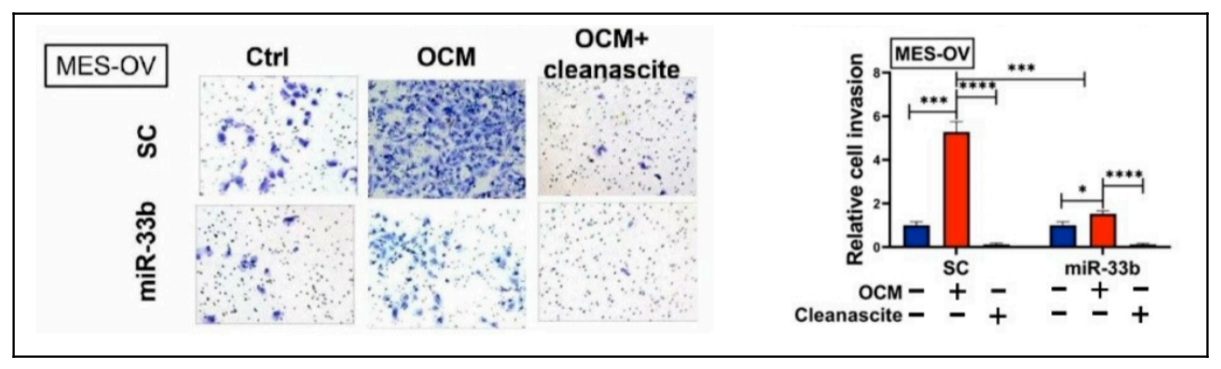
The tumor microenvir-onment is known to influence cancer epigenomics, which plays an essential role in promoting tumor development and metastatic progression. To study this, the researchers used ovarian cancer cells cocultured in omental conditioned medium (OCM), which mimics the ascites microenvironment, and in vivo tumor growth. To examine whether fatty acids in OCM are the main source of energy for tumors, all fatty acids in OCM were first removed by CleanasciteTM Lipid Removal Reagent. The article states “The omental mixture was subsequently added to the cell culture medium supplemented with 1% FBS for 24 h. OCM was filtered and stored at 4 °C prior to the removal of omentum tissues by centrifugation. To selectively remove lipids and cell debris, Cleanascite™ … was employed for OCM according to the manufacturer’s suggestions.” XTT cell viability analysis was performed and showed that the cell growth rate of ES-2 and MES-OV cells was remarkably reduced when cocultured in lipid-depleted OCM. The effective use of Cleanascite™ helped establish that “both miR-33b overexpression and depletion of fatty acids by Cleanascite in OCM significantly impaired ovarian cancer cell migration and invasion.” The article concludes that that miR-33b is significantly silenced by DNA hypermethylation in metastatic ovarian cancer cells, to adapt to a lipid-rich microenvironment. Restoration of miR-33b was shown to impair lipid metabolic activities and reduce the oncogenic properties of ovarian cancer cells by negatively regulating the TAK1/FASN/CPT1A/NF-κB pathway, indicating that targeting this signaling cascade may be a molecular therapeutic choice for ovarian cancer metastatic progression. “Its very rewarding to see how Cleanascite™ can enhance cancer research associated with the selective removal of fatty acids. Whenever an investigation needs to consider whether lipids influence cell culture response, Cleanascite™ can be used. It is an aqueous suspension product without harmful solvents, or any other non-specific cytotoxic effects. This ultimately helps researchers decide whether or not lipids, or factors interacting with lipids, impart characteristic changes in cells. This article exemplifies such utility.” states Swapan Roy, Ph.D., President and Founder of Biotech Support Group
Click to download whitepaper entitled “Cleanascite™ - Lipid Removal and Cell Response Applications”
Click to visit Cleanascite™ product page and ordering information
Converging with cultural and technological disruptions forthcoming in healthcare, Biotech Support Group develops methods for cost effective and efficient sample prep essential for these expanding markets. Following a tiered business strategy, the company continues its growth in the consumable research products area supporting the rapidly expanding installation of LC-MS instrument and computational infrastructure. For this market, key products include: AlbuVoid™ and AlbuSorb™ for albumin depletion, Cleanascite™ for lipid adsorption, HemogloBind™ and HemoVoid™ for hemoglobin removal, the company has acquired knowledgebase and biomarker intellectual property assets that support discoveries of protein markers from blood, with special emphasis on early detection and personalized medical decisions for Covid-19 and cancer patients. For more information, go to http://www.biotechsupportgroup.com. For Business Development, contact: Matthew Kuruc 732-274-2866, mkuruc@biotechsupportgroup.com
|

- About
- Products
- Hemoglobin Removal Kits
- Lipid Removal & Clarification
- Urine Protein & Low Abundance Enrichment
- Class Specific Enrichment
- Sample Prep Mass Spectrometry
- Functional & Chemical Proteomics
- Genomic Sample Prep
- Accessories
- Technical Resources
- References
- Publications & Reports
- FAQs
- Case Studies
- Cleanascite™ Unlocks Insights into Lipid-Driven Tumor Immunosuppression
- NRicher™ Bead Platform Provides Unique Sub-Proteome Biases And Fit For Purpose Opportunities for Targeted LC-MS Quantification
- BSG Products To Assist in Analyzing Macrophage Polarization
- Ectodomain Shedding and Enrichment of the Soluble Membrane Proteome
- Investigate out of the Venn Diagram box
- Methods to selectively deplete or purify Hemoglobin from Dried Blood Spots (DBS)
- The Utility of HemoVoid™ is Demonstrated in 3 Proteomic Investigations Identifying Potential Disease Specific Biomarkers
- The 4 common features of our sample prep products, known as the BSG Advantage, are highlighted in a selection of journal references.
- AlbuVoid™ Workflows Advance Cell Secretome Proteomics
- Lipid Removal for Phenotypic Cell Response in Cancer Research
- The Influence of Sample Prep Bias on LC-MS Targeted Peptide Quantification in Serum Proteomics
- Re-imagining proteomics for developing precision medicine biomarkers of the innate immune response in SARS-CoV-2
- Patent Application Describes New Proteomic Methods to Monitor Protease Inhibitor Function During Covid-19 Infections
- Efficient Hemoglobin Removal Advances Red Cell Proteomics Offering Many New Insights Into Inflammation and Infectious Disease
- The Potential for New Blood Biomarkers in the Management of COVID-19 Disease
- Establishing the Utility of HemoVoid™ and HemogloBind™ as Enrichment Tools for Proteomic Analysis of Red Cells and Whole Blood in Parkinson’s Disease
- Species Diversity Supported By BSG Products
- Poster Report Describes Loss of Functional Serpin Activity In Cancer Patient Blood
- AlbuVoid™️ PLUS & AlbuSorb™️ PLUS Evaluating Different Windows of Observation Solves The Many Challenges of Serum Proteomics
- Tackling the Challenges of Serum Proteomics
- Lipid Removal Sample Prep for Cell Response Applications
- Sample Prep for Proteomic Analysis of Saliva
- Biotech Support Group Featured in Book, "Functional Proteomics – Methods and Protocols"
- Sample Prep Liquid Biopsy Products Suitable for Proteomic Profiling of a Variety of Body Fluid Sample Types
- Albumin and High Abundance Depletion
- Using HemogloBind™ as a Hemoglobin Binding Reagent
- Diverse technologies available for researchers to selectively bind or enrich exosomes and extracellular vesicles.
- Stroma Liquid Biopsy™ Biomarkers Profile Pan-Cancer Dysregulation of the Serum Proteome
- Diverse Depletion and Enrichment Technologies Enhance Simplicity and Efficiency of Obtaining Quality Proteomic Information
- Use On-Bead Digestion to Improve Time Required for Serum Digestion
- Using AlbuVoid™ as a Serum Protein Enrichment Kit in Functional Proteomics
- Using Cleanascite™ as a Lipid Absorption and Clarification Reagent
- Using HemoVoid to Remove Hemoglobin Before Analysis
- Blog
- Contact
- Liquid Biopsy