
Press Release
NRicher™ – Targeted Proteomic Enrichment, Simplified & Diversified at ASMS San Diego 2026
Zheng, Roy, Zhao, Priyadarshini, Kuruc · Biotech Support Group LLC & Rutgers Center for Integrative Proteomics · ASMS 2026
Reprints: [email protected]
MONMOUTH JUNCTION, NJ, JUNE 11, 2026- Biotech Support Group (BSG) highlights NRicher™ Platform's simplified and diversified approach to targeted proteomic enrichment, presented on Thursday, June 4 in the Proteomics: Quantitative II topic area at the 74th ASMS Conference on Mass Spectrometry and Allied Topics in San Diego.
INTRODUCTION
Targeted proteomics is emerging as a foundation of next-generation clinical testing, quantifying pre-identified, disease-implicated proteins with precision and reproducibility. But serum and plasma pose a hard technical problem: high-abundance proteins and a shifting background of off-target peptides drive ion suppression, co-eluting spectral overlap, and background noise that compromise clinical utility. This work applies the NRicher™ bead platform to that problem, anchored by a proposed biomarker model for unresolved chronic inflammation
METHODS
NRicher™ beads are chemically derived from porous silica (ionic, hydrophobic, hydrogen-bonding, aromatic, polymeric surfaces), each with differential sub-proteome binding; AlbuVoid™ and HemoVoid™ are two products already commercialized from the platform. Five bead chemistries were compared in pooled human serum against a neat control digested by standard SP3.
▪ LC-MS Acquisition: targeted PRM-PASEF on a Bruker timsTOF HT, coupled to a Vanquish NEO nano-HPLC (13 min gradient), after NRicher™ prep and on-bead digestion.
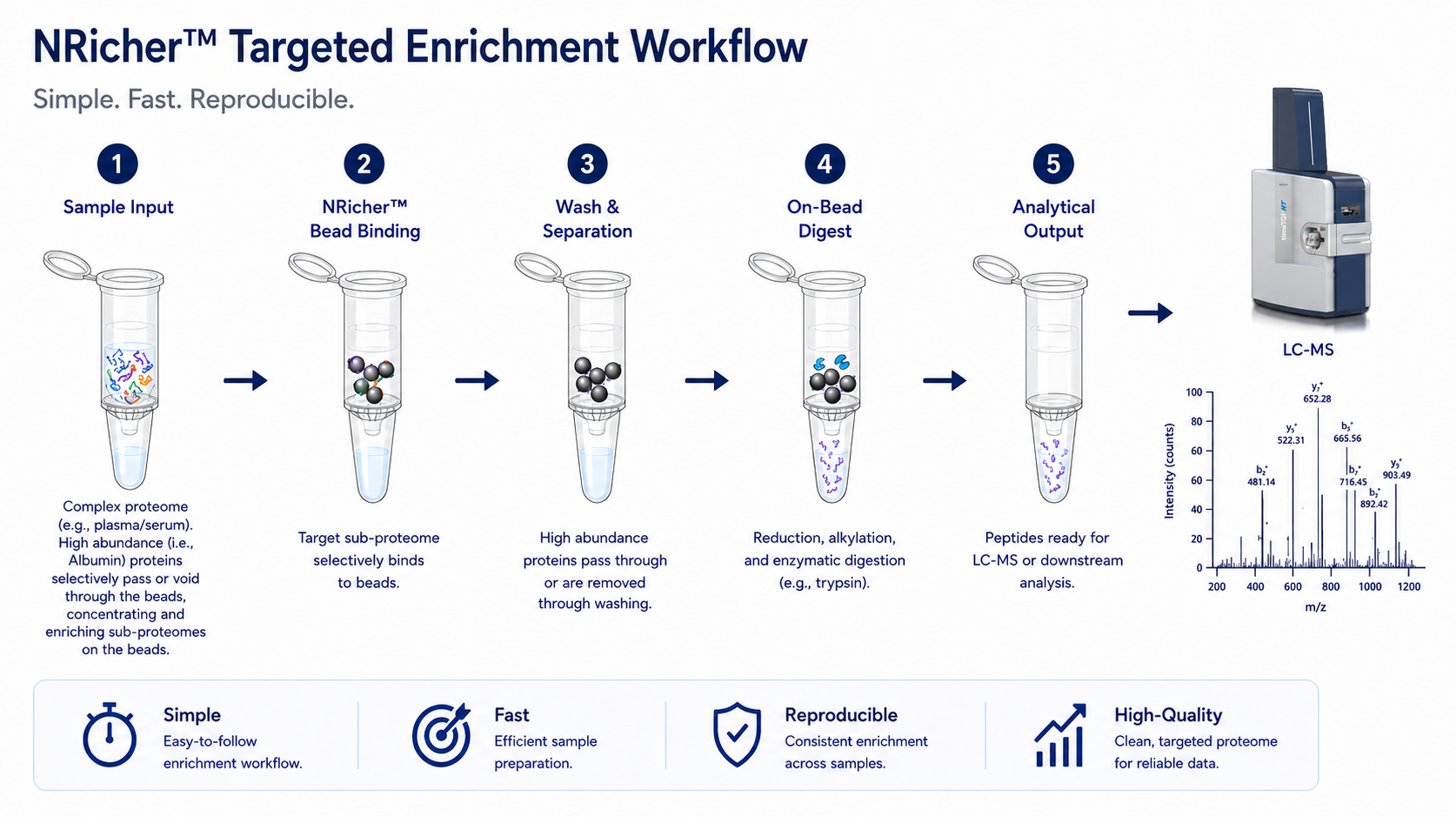
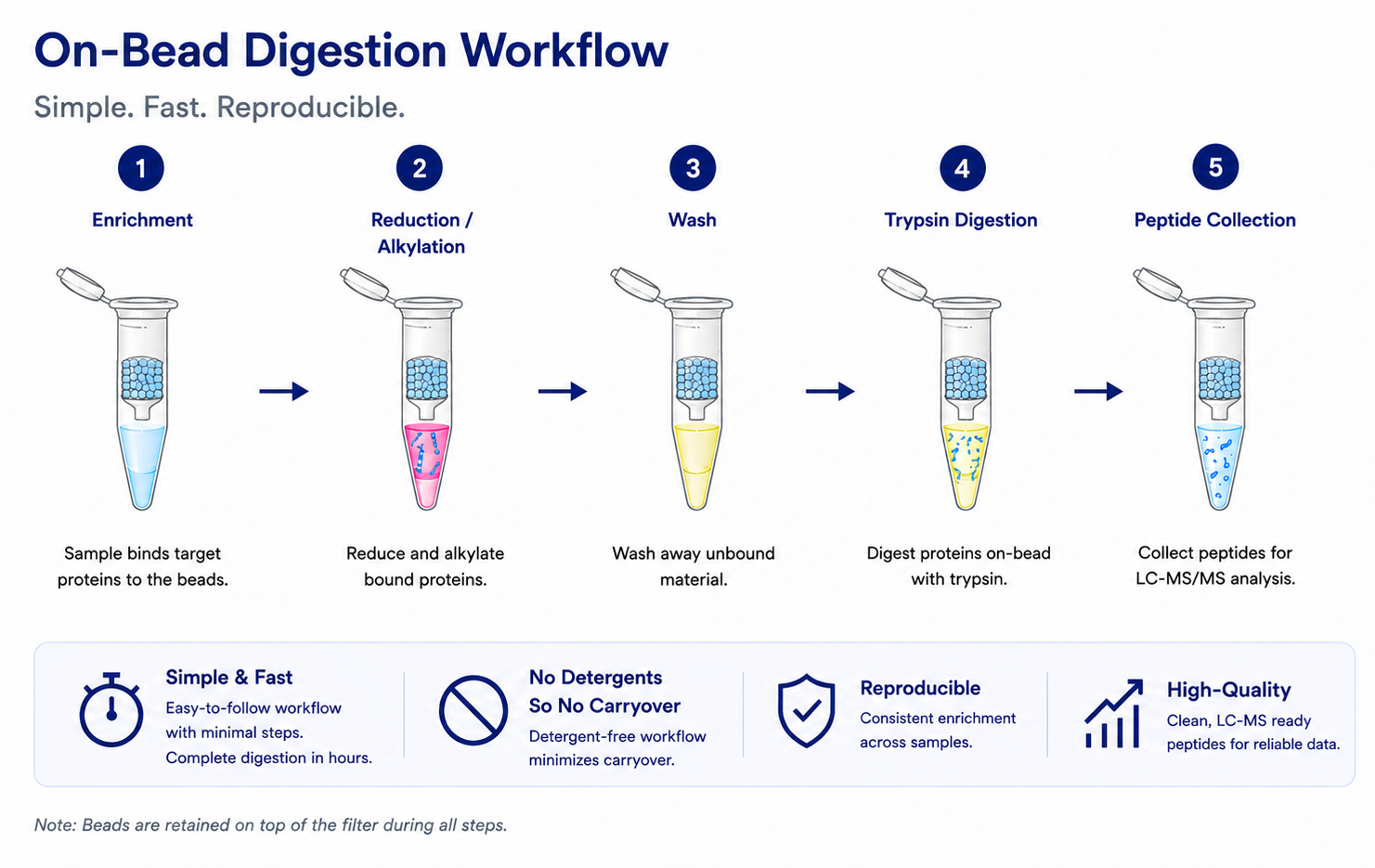
▪ Signal Processing: peak integration and manual verification in Skyline; spectral libraries built from DIA data via MSFragger and imported into Skyline.
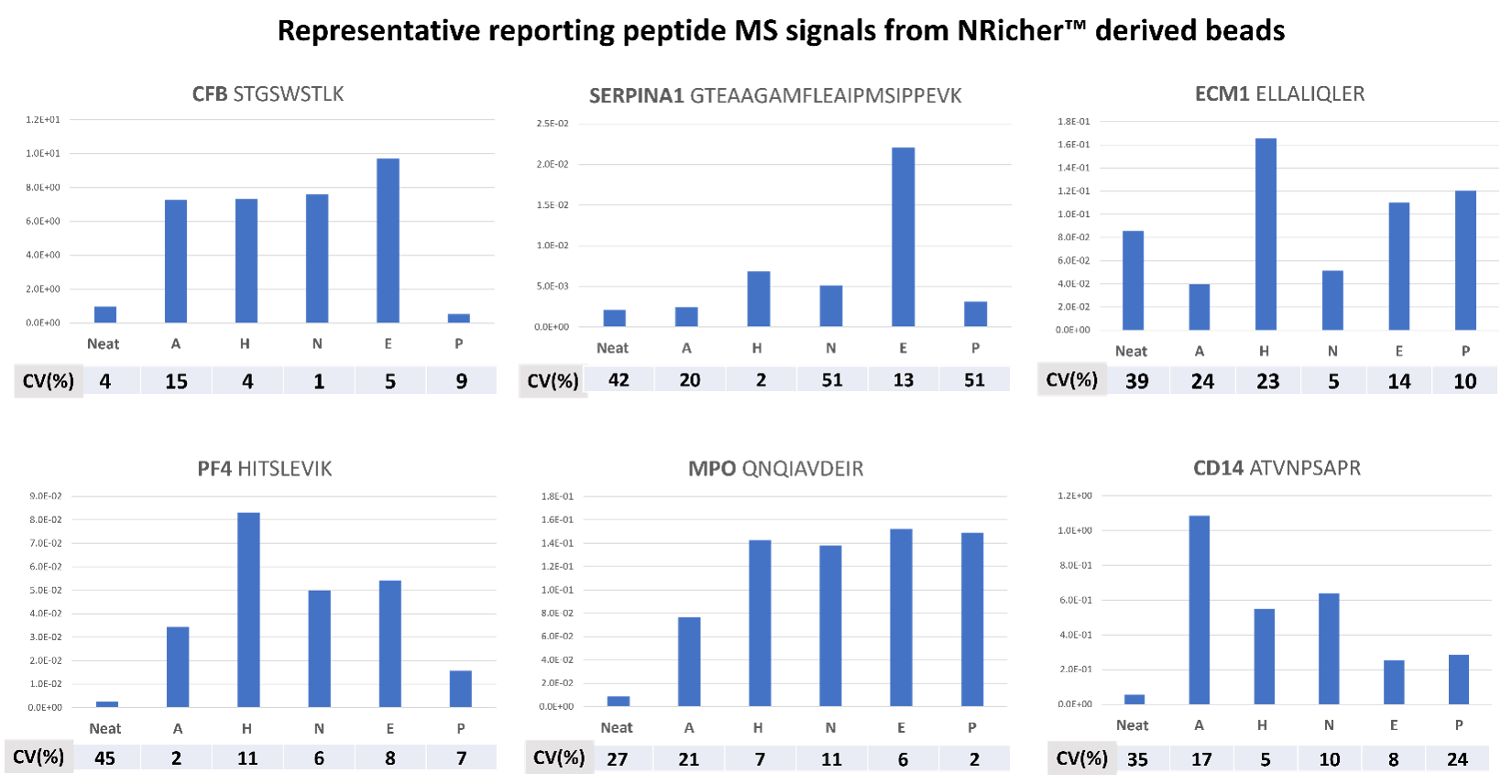
▪ Rigor: samples run in triplicate; signal normalized to the nearest-retention-time iRT (Biognosys) spike peptide, then averaged. CVs were based on total signal for the run.
RESULTS
Efficiency and selection-bias properties were characterized for five NRicher™ bead chemistries — notated A, H, N, E, P — each with a distinct surface chemistry and sub-proteome selectivity. All achieved substantial albumin depletion (~85–95%); bead “A” is the commercial AlbuVoid™ product. Signal and CV benefits concentrated in the lower-abundance range, with no substantial decline for most proteins elsewhere — so target panels varying across more than 3 logs of abundance signal can be analyzed confidently and quantitatively.
| NRicher™ Beads | FINDING |
|---|---|
| A, H, N, E, P | Distinct sub-proteome selectivity; all deplete albumin ~85–95% (A = AlbuVoid™) |
| vs. neat | Signal & CV gains focused in low-abundance proteins; >3 logs of signal quantifiable |
CONCLUSIONS
Serum/plasma proteomic discovery studies converge on a common theme — disease mechanisms trace back to dysregulated inflammation —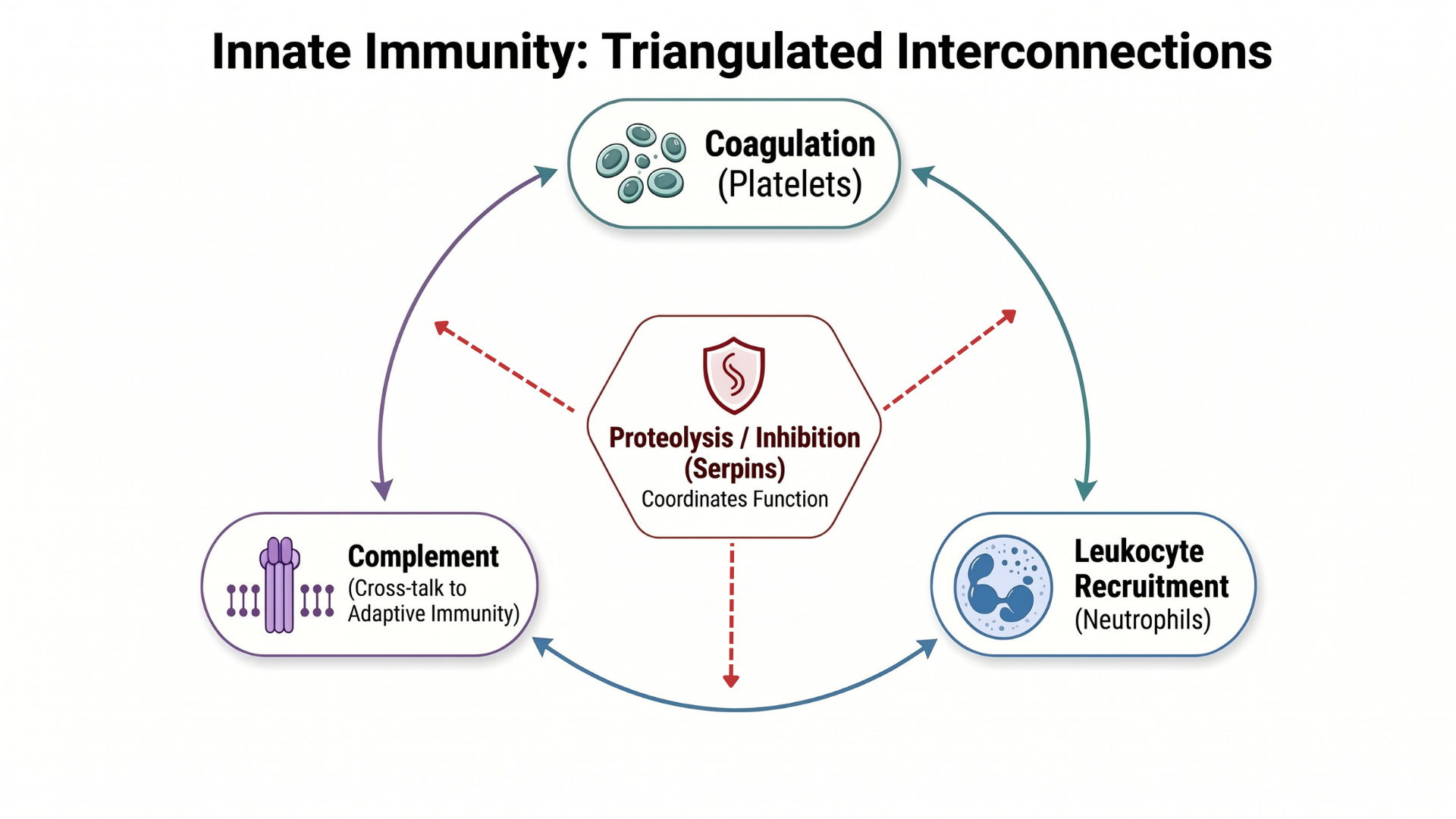 yet current inflammation biomarkers are insufficient, leaving a gaping clinical need, as inflammation that cannot be characterized cannot be treated. We have used a model of interconnected innate pathway biomarkers as a proposed panel. Nevertheless, as biomarkers move from discovery to validation to clinic, methods migrate from high-resolution instruments to workhorse triple-quadrupole (QqQ) systems, making efficient, versatile sample prep essential.
NRicher™ fits that purpose: no immuno-affinity, no HPLC, no added capital expenditure, simple workflows, starting from as little as 25 µL of serum or plasma. Methods can be optimized with buffer conditions and bead combinations. The data here is a first proof of principle for a workflow integrating albumin depletion, sub-proteome enrichment, and on-bead digestion without detergents.
Download the Poster ← Click here for Poster
Have a biomarker panel already? Download the open-access NRicher™ Knowledgebase and let us assist in new research avenues for biomarker discovery, validation and personalized medical decisions: biotechsupportgroup.com/category-s/340.htm
Keywords: NRicher™, Bead-based sample preparation, ASMS, Proteomic enrichment, AlbuVoid™, HemoVoid™, On-bead digestion, Targeted proteomics, Biomarker discovery, Mass spectrometry